

How Was Oriental Perfumery Born?
From the Gardens of Shalimar to Amouage — The Journey That Changed the History of Fragrance
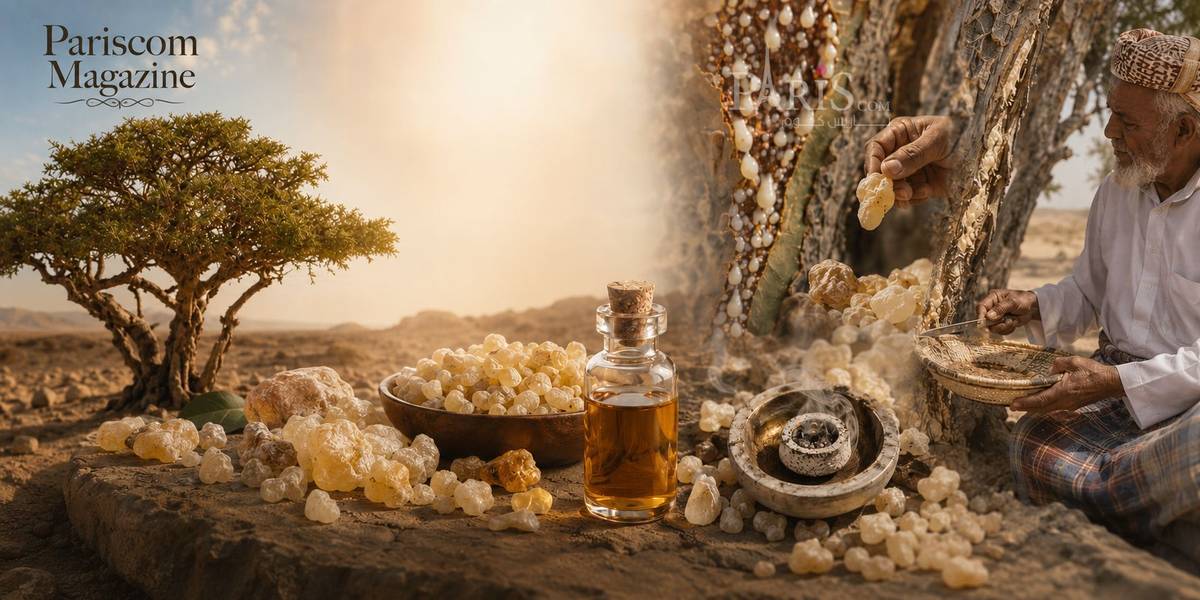
[IMAGE: Hero Banner 1600×900 | The Incense Route stretching across the Arabian Peninsula, blending into the Shalimar Gardens and ending with iconic luxury perfume bottles in Paris.]
Introduction
Long before the term Oriental fragrance appeared in perfume books and luxury boutiques, there existed a journey that stretched across deserts, kingdoms, temples, royal courts, and eventually the grand perfume houses of Paris.
It is a story that begins not with a bottle, but with smoke rising from burning frankincense.
Not with a perfumer's laboratory, but with caravans crossing the Arabian Peninsula.
Today, "Oriental" has become one of perfumery's most recognizable fragrance families.
It evokes warmth.
Depth.
Amber.
Vanilla.
Incense.
Precious woods.
Exotic spices.
And an atmosphere of mystery unlike any other.
Yet surprisingly, very few people know where the concept actually came from.
Was Oriental perfumery born in the East?
Or was it an artistic invention created by European perfumers inspired by their fascination with Eastern civilizations?
The answer is far more complex—and far more fascinating—than most fragrance lovers imagine.
Because the Oriental family was never created by a single perfumer.
Nor by a single perfume house.
Nor even by a single civilization.
It emerged from thousands of years of cultural exchange between East and West.
It is a story in which trade routes became fragrance routes.
Science became art.
History became emotion.
And perfume became the language through which two worlds learned to dream about one another.
"Oriental perfumery is not simply a fragrance family. It is one of history's longest conversations between civilizations."
Before Perfume Had a Name, the East Already Had Its Fragrance
[IMAGE: Frankincense trees in Dhofar, ancient incense caravans, oud wood, myrrh, spices.]
Long before Europe embraced perfume as an art form, the East had already mastered the value of scent.
Across Southern Arabia, particularly in today's Dhofar, ancient frankincense trees produced one of the most precious natural materials known to the ancient world.
From there, caravans traveled thousands of kilometers along what historians now call The Incense Route, carrying their treasured cargo through Yemen, the Arabian Peninsula, Petra, Damascus, Egypt, and eventually into Greece and Rome.
Their merchandise was far more valuable than simple trade goods.
It included frankincense.
Myrrh.
Rare spices.
Natural musk.
Ambergris.
Damask rose.
Saffron.
Agarwood.
Materials that were considered so precious they often rivaled gold itself.
These fragrances were burned inside temples.
Used in royal ceremonies.
Offered in sacred rituals.
Prescribed in ancient medicine.
Even employed during Egyptian mummification.
The East did not yet produce perfume in the modern French sense.
Instead, it possessed something even more important.
It possessed the raw materials that would later become the foundation of luxury perfumery itself.
To European travelers, these materials represented far more than pleasant aromas.
They represented distant kingdoms.
Hidden treasures.
Silk roads.
Golden palaces.
Unknown civilizations.
Before the East became a geographical destination, it had already become an olfactory imagination.
"Long before Paris perfumed the world, the world was already following the scent of Arabia."
When Arab Science Changed the Future of Perfumery
[IMAGE: Medieval Arab laboratory with alembic stills, rose petals, ancient manuscripts.]
Raw materials alone could never have transformed perfumery.
What changed history was knowledge.
During the Islamic Golden Age, Arab scientists revolutionized chemistry, medicine, and fragrance extraction in ways that still influence perfumery today.
Scholars such as Jabir ibn Hayyan laid the foundations of experimental chemistry.
Later, Al-Razi refined laboratory techniques that would influence generations of scientists.
Perhaps most significantly, Ibn Sina (Avicenna) perfected the process of steam distillation, allowing delicate flowers—especially roses—to be transformed into aromatic waters and essential oils with unprecedented purity.
For the first time, fragrance could be extracted without burning the flower itself.
The result was extraordinary.
Rose water became one of the most prized aromatic products in the medieval world.
Essential oils became more refined.
And perfumery began moving away from simple burning rituals toward sophisticated composition.
Through Andalusia, Sicily, Mediterranean trade routes, and centuries of cultural exchange, these scientific discoveries gradually reached Europe.
By the Renaissance, Western perfumers were no longer importing only Eastern materials.
They were also benefiting from Eastern scientific innovation.
Modern perfumery owes as much to the laboratory as it does to the flower.
And many of its earliest breakthroughs were born in the Arab world.
"The East did not merely supply perfumers with ingredients. It taught them how to capture the soul of a flower."
Europe Dreams of the East
[IMAGE: Orientalist paintings, Paris salons, exotic maps, silk and spices.]
By the nineteenth century, Europe had already fallen in love with an imagined East.
Travel literature.
Orientalist paintings.
World exhibitions.
Opera.
Poetry.
Architecture.
Together, they created an image of the Orient that blended reality with fantasy.
The East became a symbol of mystery.
Golden palaces.
Silken curtains.
Incense-filled rooms.
Endless deserts.
Jewels.
Royal gardens.
It was less a geographical location than a romantic dream.
That dream soon found its way into perfume.
European perfumers were no longer using frankincense, vanilla, balsams, and spices simply because they smelled beautiful.
They used them because they told a story.
A story of luxury.
Distance.
Passion.
Adventure.
Yet something was still missing.
These magnificent ingredients had not yet become a distinct fragrance family.
That transformation would finally occur in Paris.
And one perfume would change perfumery forever. Paris — The City That Reinvented the East
[IMAGE: Paris in the 1920s, the historic Guerlain boutique, antique maps of India and the Middle East, glowing amber tones.]
By the early twentieth century, Europe had already discovered the treasures of the East.
Frankincense.
Myrrh.
Vanilla.
Natural musk.
Ambergris.
Rare spices.
Precious woods.
Yet despite their extraordinary beauty, these materials still belonged to no unified olfactory identity.
They appeared individually in countless perfumes, but they had not yet become a fragrance family.
That would soon change.
Paris, now emerging as the world's creative capital of perfumery, was captivated by an idealized vision of the Orient.
Novelists described magnificent palaces hidden behind carved wooden doors.
Artists painted glowing deserts beneath crimson sunsets.
Opera composers filled European theatres with stories inspired by Persia, India, Arabia, and the Ottoman Empire.
To Europeans of the Belle Époque, the East represented far more than geography.
It symbolized mystery.
Luxury.
Passion.
Spirituality.
A world where perfume was woven into daily life.
Whether these images reflected historical reality mattered less than the emotions they inspired.
Perfumers were no longer simply composing fragrances.
They were composing dreams.
And those dreams would soon find their greatest expression inside a single bottle.
"Europe did not fall in love with the East it knew. It fell in love with the East it imagined."
Shalimar — The Perfume That Created a Fragrance Family
[IMAGE: Guerlain Shalimar beside the Shalimar Gardens and the Taj Mahal.]
In 1925, Jacques Guerlain introduced what many perfume historians consider one of the most influential fragrances ever created.
Its name was Shalimar.
Inspired by the legendary love story of Emperor Shah Jahan and Mumtaz Mahal, the fragrance borrowed its name from the magnificent Shalimar Gardens, built as a symbol of eternal devotion.
Yet Shalimar's true revolution had little to do with its romantic narrative.
Its greatness lay in its composition.
Never before had vanilla been used with such richness and confidence.
Supported by luminous bergamot, powdery iris, balsamic resins, incense, and warm oriental accords, Shalimar created an entirely new olfactory experience.
It was sensual without being overwhelming.
Luxurious without being excessive.
Warm, mysterious, and deeply memorable.
More importantly, it gave perfumers something they had never possessed before:
A complete artistic language for expressing the imagined East.
Although earlier fragrances had featured many of the same materials, Shalimar was the perfume that united them into a coherent identity.
From that moment forward, perfumers and critics began referring to this style as the Oriental fragrance family.
It became more than a successful perfume.
It became the blueprint for one of perfumery's most influential traditions.
"Shalimar was not the first perfume to use Eastern ingredients. It was the first to transform them into an artistic language."
Is an Oriental Fragrance Truly Oriental?
[IMAGE: Split composition showing authentic Eastern raw materials beside a classic French perfume laboratory.]
At first glance, the answer seems obvious.
Surely an Oriental fragrance must come from the Orient.
History tells a different story.
Frankincense originated in Southern Arabia.
Oud traveled from Southeast Asia.
Natural musk came from Central Asia.
Ambergris drifted across the oceans.
Vanilla arrived from the Americas.
Damask roses flourished throughout the Middle East.
Yet the fragrance family that united these materials into a recognizable artistic style was born not in the East, but in France.
This distinction is essential.
The East supplied the world's greatest aromatic treasures.
France transformed those treasures into a structured olfactory language.
In other words, Oriental perfumery is less a geographical category than an artistic interpretation.
It represents Europe's vision of the East rather than the East itself.
That interpretation would shape perfumery for more than a century and influence thousands of fragrances created across every continent.
Even today, nearly every warm amber fragrance owes something to the creative revolution that began with Shalimar.
"The East gave perfumery its treasures. Paris gave those treasures a name."
Why the Word "Oriental" Is Gradually Disappearing
[IMAGE: Classic Shalimar beside a contemporary amber fragrance, with Paris and the Arabian Peninsula connected through light.]
For almost a century, Oriental was one of the most familiar fragrance families in perfumery.
Collectors used it.
Critics used it.
Perfumers used it.
Every fragrance guide featured it.
Yet over the past decade, something remarkable has happened.
The word has begun to disappear.
Not because these fragrances have vanished.
But because the language surrounding them has evolved.
Outside the perfume industry, the word Oriental has increasingly been viewed as an outdated and overly broad cultural description of Asian and Middle Eastern peoples.
As discussions around cultural representation grew, many institutions, publishers, and brands began reducing its use.
Perfumery naturally followed.
Rather than abandoning the fragrance family itself, leading organizations gradually adopted a more descriptive vocabulary.
Today, many perfume houses and classification systems—including the Fragrance Foundation—prefer terms such as Amber or Ambery when referring to fragrances that were traditionally classified as Oriental.
The emphasis shifted away from geography.
Instead, it focused on olfactory character.
Warmth.
Resins.
Vanilla.
Incense.
Balsams.
Soft spices.
The perfume remained exactly the same.
Only the name changed.
It is one of the clearest examples of how language evolves while artistic traditions continue uninterrupted.
"The fragrance did not change. Only the words used to describe it did."
When the East Began Telling Its Own Story
[IMAGE: Amouage, Oman Luxury, Arabian Oud, Abdul Samad Al Qurashi, surrounded by frankincense and oud.]
For decades, the world's understanding of the Orient was largely filtered through European imagination.
French perfumers introduced Western audiences to an idealized vision of Eastern luxury.
But toward the end of the twentieth century, something extraordinary happened.
The East began speaking for itself.
Luxury perfume houses from the Middle East emerged with a confidence that no longer relied on European interpretation.
They were not recreating an imagined Orient.
They were expressing a lived one.
Among the most influential was Amouage, founded in Oman in 1983.
Rather than using frankincense merely as an exotic accent, Amouage placed Omani frankincense at the very heart of its identity.
The result was not nostalgia.
It was authenticity.
Soon, other houses followed.
Oman Luxury celebrated the landscapes and traditions of the Sultanate.
Abdul Samad Al Qurashi elevated oud, musk, amber, and Taif rose through generations of Arabian craftsmanship.
Arabian Oud, The Spirit of Dubai, and many others presented the richness of Middle Eastern perfumery from within its own culture rather than through Western fantasy.
For the first time in modern perfume history, the East was no longer simply inspiring luxury fragrance.
It had become one of its leading creative voices.
This new chapter did not replace the French Oriental tradition.
It complemented it.
One imagined the East.
The other lived it.
Together, they expanded the language of perfumery beyond anything previous generations could have imagined.
"For decades, the West dreamed about the East. Today, the East tells its own story."
Does Oud Automatically Make a Fragrance Oriental?
[IMAGE: Oud wood, vanilla pods, amber accords, incense, and modern niche perfume bottles.]
One of the most common misconceptions in perfumery is surprisingly simple.
If a fragrance contains oud, it must be Oriental.
In reality, that is not how fragrance classification works.
No single ingredient defines an entire fragrance family.
Oud may appear in a woody fragrance.
A leather fragrance.
A smoky composition.
Or an amber fragrance.
Its presence alone determines nothing.
The same is true of vanilla.
Frankincense.
Amber.
Or musk.
An Oriental—or, in modern terminology, Amber—fragrance is defined not by one material but by its overall architecture.
Its warmth.
Its richness.
Its velvety depth.
Its enveloping character.
This explains why some fragrances contain no oud whatsoever yet remain unmistakably amber in style.
Conversely, many contemporary oud fragrances are classified primarily as woody compositions rather than amber fragrances.
The secret lies not in the ingredient list.
But in the emotional experience the composition creates.
"An Oriental fragrance is not identified by what it contains—but by what it makes you feel."
How Modern Master Perfumers View the Oriental Tradition
[IMAGE: Francis Kurkdjian, Dominique Ropion, Jean-Claude Ellena alongside frankincense, oud, amber, and vanilla.]
A century after Shalimar forever changed perfumery, the Oriental family has become far more than a historical chapter.
It has become a creative language.
One spoken differently by every great perfumer.
Dominique Ropion approaches amber compositions like an architect.
His Oriental creations are structured, powerful, and meticulously balanced, where every rich material serves a precise purpose rather than overwhelming the composition.
Francis Kurkdjian, on the other hand, often explores warmth through transparency.
His amber accords glow rather than dominate, proving that an Oriental fragrance can feel luminous, contemporary, and remarkably weightless while still possessing extraordinary depth.
Then there is Jean-Claude Ellena, whose philosophy seems almost paradoxical.
Where others seek richness, Ellena searches for silence.
He demonstrates that an amber fragrance does not require excessive density.
Instead, carefully placed spaces between notes allow the imagination to complete the composition.
Meanwhile, many contemporary Middle Eastern perfume houses have introduced yet another perspective.
Rather than imagining the Orient, they express it from lived experience.
Frankincense is no longer an exotic fantasy.
It is heritage.
Oud is no longer a symbol of mystery.
It is culture.
Rose is no longer interpreted through European romanticism.
It is celebrated as part of everyday tradition.
The Oriental family therefore continues to evolve.
Not by abandoning its past.
But by welcoming new voices into a conversation that began thousands of years ago.
"Oriental perfumery is no longer a single style. It has become a global language spoken with countless accents."
Conclusion — When East and West Learned to Dream Together
[IMAGE: The Incense Route blending into Paris, Shalimar Gardens, and modern luxury perfume bottles.]
Oriental perfumery was never born in one country.
Nor inside one laboratory.
Nor through one extraordinary perfume.
Its story began when incense drifted through the temples of ancient Arabia.
It continued when Arab scholars transformed fragrance extraction into science.
It evolved as precious materials traveled across continents through merchants and explorers.
Centuries later, Paris embraced those treasures and gave them a new artistic identity.
Then Shalimar transformed that vision into one of history's most influential fragrances.
Yet the story did not end there.
In recent decades, the East has reclaimed its own narrative.
Luxury perfume houses from Oman, Saudi Arabia, the United Arab Emirates, and beyond have shown the world that Oriental perfumery is not simply a European interpretation of distant lands.
It is also a living tradition with its own authentic voice.
Today, whether we describe these fragrances as Oriental, Amber, or Ambery, their essence remains unchanged.
They celebrate warmth.
Emotion.
Mystery.
Memory.
Perhaps that is why this fragrance family has never belonged exclusively to East or West.
It belongs to everyone who has ever been moved by the quiet beauty of incense, the richness of vanilla, the elegance of amber, or the timeless depth of oud.
The greatest perfume traditions do not erase cultural boundaries.
They reveal how deeply those cultures have always been connected.
"The East gave perfumery its treasures. The West gave them a new artistic language. Together, they created one of fragrance's greatest traditions."
Frequently Asked Questions (FAQ)
What is an Oriental fragrance?
Traditionally, an Oriental fragrance refers to a perfume built around warm, rich materials such as vanilla, amber accords, balsamic resins, incense, musk, and exotic spices. In many modern fragrance classifications, this family is now referred to as the Amber fragrance family.
Was Oriental perfumery actually created in the East?
Not exactly.
The precious ingredients originated largely in the Middle East, Asia, and surrounding regions, but the Oriental fragrance family as a formal artistic classification was developed by French perfumers during the early twentieth century, particularly after the success of Shalimar.
Why is the word "Oriental" used less frequently today?
Many organizations and perfume brands have gradually adopted the terms Amber or Ambery, reflecting evolving cultural language while describing the same warm fragrance style more precisely.
What is the difference between Oriental and Amber fragrances?
In modern perfumery, there is often little practical difference.
Amber has largely replaced Oriental as the preferred terminology, while the fragrance profile—warm, sensual, resinous, and rich—remains essentially the same.
Which perfume established the Oriental fragrance family?
Although many earlier perfumes used Eastern materials, Shalimar by Guerlain (1925) is widely regarded as the fragrance that defined the modern Oriental family and influenced generations of perfumers.
Does every oud fragrance belong to the Oriental family?
No.
Oud is simply one ingredient.
Depending on its composition, a fragrance featuring oud may be classified as woody, leather, smoky, amber, or even floral-woody.
The overall structure—not a single ingredient—determines the fragrance family.
Which ingredients are most commonly associated with Oriental fragrances?
Typical materials include:
- Vanilla
- Amber accords
- Frankincense
- Myrrh
- Oud
- Musk
- Benzoin
- Labdanum
- Tonka bean
- Warm spices such as cinnamon, cardamom, saffron, and cloves
Related Articles
- Guerlain — The French Empire That Shaped the History of Perfumery
- Amouage — The Gift of Kings from Oman
- Francis Kurkdjian — The Perfumer Who Turned Ideas into Fragrance
- Dominique Ropion — The Architect of Modern Perfumery
- How Master Perfumers Think