
Ybry Paris | The Perfume House That Disappeared for a Century — and Came Back as Art
When a forgotten Parisian atelier reimagines the perfume as a precious stone
Some perfume houses are built to sell fragrance.
Others are built to make a statement.
And then — very rarely — one appears that seems to exist for an entirely different reason: to remind you that a perfume was never just a scent. That once, not so long ago, a bottle could be a jewel. A work of art. An object worth keeping long after the last drop was gone.
Ybry Paris is that kind of house.
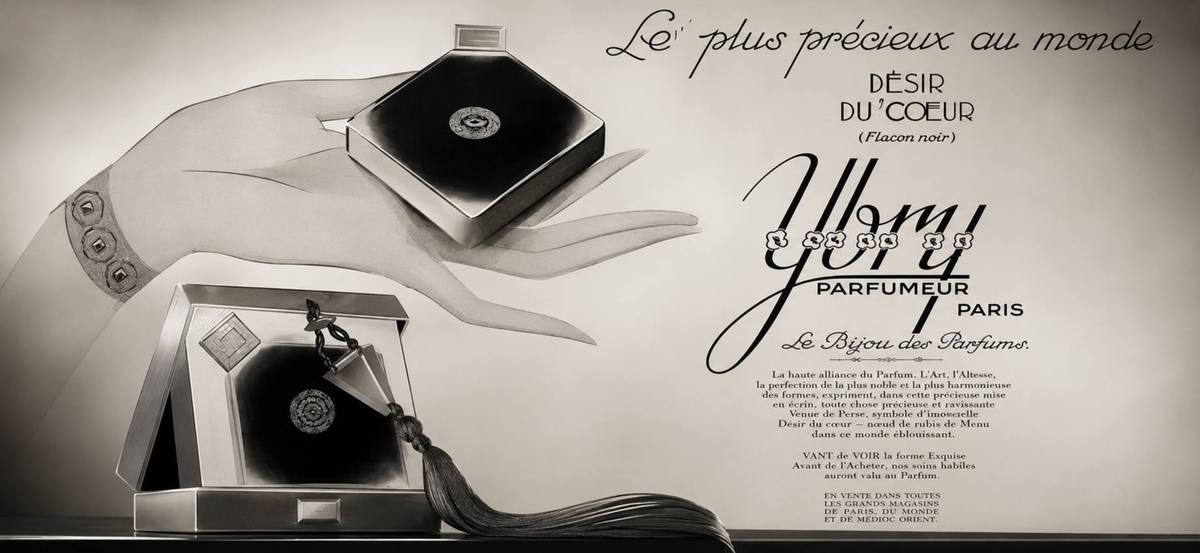
Founded in 1925 at the height of Parisian Art Deco extravagance, Ybry rose quickly to become one of the most rarefied names in French perfumery — not merely for its fragrances, but for the radical idea behind them. The perfume as gemstone. The bottle as sculpture. The purchase as acquisition, not consumption.
Then the Great Depression arrived, and Ybry — along with much of that gilded world — disappeared.
For nearly a century, the name survived only in the memories of vintage bottle collectors and fragrance historians who spoke of it in the way people speak of things that were almost too beautiful to last.
Until now.
Paris, 1925: The Birth of an Obsession
The year was 1925. Paris was at its most intoxicating.
The Exposition Internationale des Arts Décoratifs had just opened its gates, giving the world a new aesthetic language — geometric, lavish, unafraid. Fashion houses were reimagining what luxury meant. Artists were collaborating with craftsmen in ways that had never happened before. And the city itself seemed to believe, collectively, that beauty was the most serious business in the world.
It was into this atmosphere that Simon Jaroslawski launched Ybry.
His ambition was singular: to create perfumes whose bottles would be considered fine objects in their own right — worthy of the same reverence as a Cartier brooch or a Lalique vase.
He succeeded. Working with the legendary crystal houses Baccarat and Lalique, Ybry produced flacons that European fashion press described as "the most expensive perfumes in the world" — not as hyperbole, but as straightforward fact. The clientele was aristocratic. The quantities were limited. The intention was always permanence over commerce.
Then came 1929. The markets collapsed. The world that had made Ybry possible began to dissolve.
And Ybry went with it.
The Return: One Hundred Years Later
The story of Ybry's revival begins with a Yemeni perfumer named Habib Al-Suwaidi.
If the name is familiar to niche fragrance enthusiasts, it's because Al-Suwaidi is the founder of — the Franco-Arabian house that caught the attention of the niche world by doing something remarkably difficult: combining authentic Arabian raw materials with genuine French perfumery craft, without either element compromising the other.
Al-Suwaidi didn't approach Ybry as a branding exercise.
He approached it as a question.
What would it mean to revive a house whose entire identity was built on the idea that a perfume should be treated like a gemstone?
The answer took the form of a collection of seven fragrances — each one named for a precious stone, each one translated from mineral to molecule by a different world-class perfumer. The collection was unveiled at TFWA Cannes 2025, and the fragrance world took notice.
The Gemstone Collection: Seven Stones, Seven Perfumers, Seven Worlds
What makes the Gemstone Collection conceptually coherent is that it doesn't merely borrow the names of precious stones as decoration. Each fragrance attempts something more demanding: to translate the feeling of a stone — its color, its light, its emotional weight — into olfactory language.
Ybry Ambre — Warm Resin, Dark Gold
Perfumer: Alex Lee
Ambre opens with an immediately arresting combination of pink pepper, black pepper, and saffron — spiced and opaque, the olfactory equivalent of candlelight in a dark room. The heart deepens into labdanum, cashmeran, and sandalwood, building a leathery, resinous texture that feels almost tactile. The base — grey amber, ambery woods, and oakmoss — anchors the whole composition with a dry, aristocratic elegance.
This is amber as it deserves to be interpreted: not sweet, not simple, but complex, shadowed, and entirely confident.
Ybry Amethyste — Violet Light, Creamy Depth
Perfumer: Violaine Collas
Amethyste opens with a deliberate tension — bergamot and bitter orange meeting incense in a combination that feels simultaneously cool and smoldering. The floral heart of tuberose, orange blossom, and ylang-ylang gradually warms the composition, drawing it toward something more intimate. Vanilla, oakmoss, and amber close it gently, leaving a trail that is creamy without being sweet, and feminine without being soft.
If amethyst as a stone carries connotations of calm authority, this fragrance earns that association honestly.
Ybry Emeraude — Green Light, Silk and Dew
Perfumer: Anne Flipo
The most transparent fragrance in the collection, and perhaps the most technically precise. Emeraude opens with mandarin, pear, and peach — a fruit accord that is ripe without being obvious — before moving into a sheer floral heart of iris, ambrette, rose, and lily of the valley. The dry-down, built on vanilla, cedarwood, and white musk, is as delicate as the light passing through a faceted green stone.
Anne Flipo is a perfumer known for precision and restraint. Emeraude is a perfect expression of both.
Ybry Moissanite — The Darkest Stone
Perfumer: Alex Lee
If Emeraude is daylight through glass, Moissanite is what happens after dark.
The opening — blackberry, saffron, cardamom — is dense and almost edible, but with a darkness underneath it that prevents any sweetness from settling. A leathery heart of labdanum and rose deepens the composition further before a base of oud, vanilla, and patchouli closes it with considerable authority.
This is the fragrance in the collection that demands the most from its wearer. It gives back accordingly.
Ybry Turquoise — White Flowers, Modern Skin
Perfumer: Nathalie Lorson
Turquoise opens brightly — pink pepper, freesia, peony — before settling into a creamy white floral heart anchored by gardenia and tuberose. The base of musk, benzoin, labdanum, and ambroxan keeps the composition contemporary and close to skin, preventing the white florals from becoming operatic.
The result is a fragrance that manages the difficult balance between presence and discretion — the olfactory equivalent of understated elegance.
Ybry Rubis — Dark Cherry, Deep Seduction
Perfumer: Bruno Jovanovic
Rubis is built around black cherry, but not in the way most cherry fragrances approach the note — sugary, transparent, uncomplicated. Here, the cherry is darkened by freesia and orange at the opening, deepened by violet, rose, and Peru balsam in the heart, and grounded by patchouli, heliotrope, and Haitian vetiver at the base.
The result is a fragrance of considerable sensual intelligence — rich, a little dangerous, and very difficult to forget.
Ybry Quartz Rose — Velvet Fruit, Soft Modernity
Perfumer: Romain Almairac
Quartz Rose is the most approachable fragrance in the collection — and the one that earns its approachability without sacrificing character. Blackcurrant, cherry, and fig in the opening give it a lush, slightly tart fruitiness that is neither childish nor generic. The rose and violet heart softens it, and the base of oakmoss, caramel, and ambroxan lands it in a gourmand register that is restrained enough to feel genuinely sophisticated.
Romain Almairac is one of the most skilled practitioners of contemporary femininity in fragrance. This is him at his most persuasive.
More Than Perfume
What Ybry Paris is attempting — consciously or not — is a restoration of something the fragrance industry largely abandoned in the pursuit of scale: the idea that a bottle of perfume could be an heirloom.
Not a product to be finished and replaced.
Not a flanker of a flanker of a franchise.
But an object — beautiful, rare, considered — that carries meaning beyond its contents.
In a market saturated with launches, limited editions, and celebrity collaborations, that ambition is either naive or visionary.
Given the quality of the perfumers involved, and the coherence of the collection's concept, it feels closer to the latter.
Frequently Asked Questions
What is Ybry Paris?
Ybry Paris is a French niche perfume house originally founded in 1925 by Simon Jaroslawski. It was known for producing perfumes in crystal flacons created in collaboration with Baccarat and Lalique, and was considered among the most exclusive perfume houses of its era before closing during the Great Depression.
Who is behind the revival of Ybry Paris?
The revival is led by Habib Al-Suwaidi, founder of niche house Reine de Saba, who brings the same philosophy of craft and cultural depth that defines his earlier work.
What is the Gemstone Collection?
The Gemstone Collection is Ybry's debut release under its new direction — seven fragrances, each named for and conceptually inspired by a precious stone: Rubis, Moissanite, Emeraude, Quartz Rose, Turquoise, Amethyste, and Ambre.
Who created the fragrances?
Each fragrance in the collection was created by a different internationally recognized perfumer, including Alex Lee, Violaine Collas, Anne Flipo, Bruno Jovanovic, Nathalie Lorson, and Romain Almairac.
Where was the collection first presented?
The collection made its public debut at TFWA Cannes 2025.
Are the fragrances unisex?
The collection is presented without gender designation. In practice, some fragrances — Moissanite, Ambre, Rubis — lean toward richer, more traditionally masculine registers, while Emeraude, Turquoise, and Quartz Rose carry a more traditionally feminine character. Amethyste sits comfortably between both.
Where can I find Ybry Paris fragrances?
The collection is available through , with delivery across Saudi Arabia.
The Verdict
A century is a long time to be absent. But Ybry Paris returns not as nostalgia, and not as novelty — but as a genuine point of view about what luxury in fragrance should mean.
The gemstone concept could have been superficial. Instead, it gives the collection a conceptual spine that holds, a reason for each fragrance to exist beyond commercial calculation.
In a category where originality is the rarest luxury of all, that might be the most valuable thing Ybry Paris offers.